
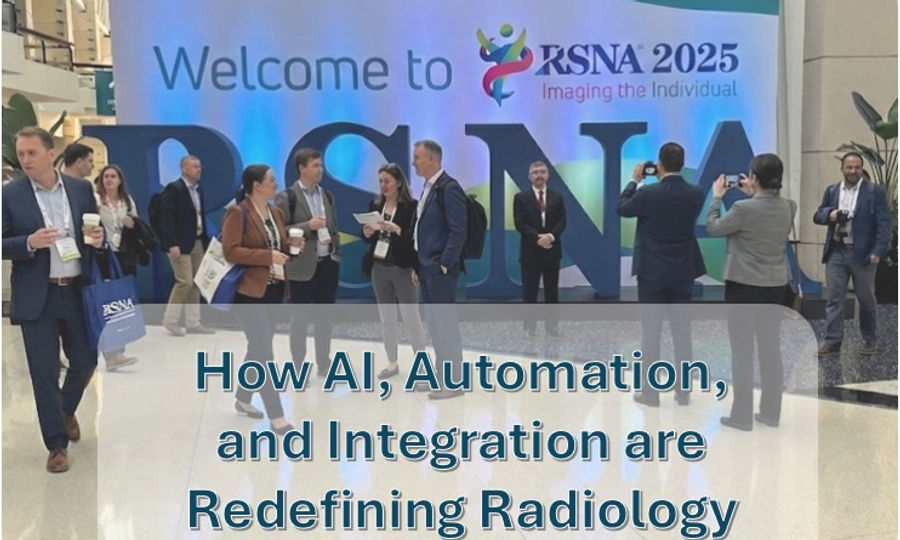
Multimodal AI, automated reporting, integrated portfolios, and distributed ecosystems are reshaping how image intelligence is interpreted, documented, and integrated across enterprise systems.
RSNA 2025 highlighted that while modality-level innovation remains central to radiology’s progress, a complementary set of changes is emerging in how image intelligence—augmented by patient context, risk information, and clinical guidelines—is interpreted, documented, and integrated across enterprise systems. Multimodal AI, automated reporting, integrated solution portfolios, distributed ecosystems, and operational automation are reshaping how radiology is practiced and scaled.
These developments are not tied to any single product category or vendor strategy. Instead, they reflect a broader reorientation toward system-level design—how interpretation, reporting, and downstream integration are evolving as AI becomes more deeply embedded in radiology practice. Individually, each shift is incremental; together, they signal a structural change in how imaging intelligence is produced and delivered.
RSNA 2025 also remained a technically rich meeting. Advances in photon-counting CT, AI-driven reconstruction, detector physics, and modality-specific performance improvements across CT, MR, and PET continue to push image quality, dose efficiency, and diagnostic capability forward. These advances progress along their own trajectories, alongside the system-level changes discussed here.
A central theme was the maturation of multimodal intelligence, with systems increasingly designed as continuously present reasoning layers rather than isolated tools. Within this context, AI-assisted reporting is emerging as a credible near-term opportunity for scaled impact. While broad transformation is likely still a couple of RSNA cycles away, progress in report drafting and structuring reflects the convergence of efficiency pressures, staffing constraints, and maturing large language models.
At the market level, vendors are moving away from single-algorithm solutions toward integrated portfolios, while simultaneously embracing distributed ecosystems and partnerships over closed platforms. Together, these shifts suggest that radiology’s center of gravity is expanding—from better images alone to better systems that embed, connect, and scale intelligence across the enterprise.
Read the full analysis, including a detailed breakdown of the five key shifts, here: Five Workflow and AI-Centric Trends Shaping the Next Phase of Radiology - Health Tech Strategies
Related FHA services
Explore how FHA supports teams across regulatory strategy, evidence, reimbursement, and AI/ML product guidance.
Our ExpertiseMore from HealthTech Horizons
HealthTech Horizons
DiMe Releases New AI Implementation Playbook
Shannon Campbell, PhD · November 27, 2025
HealthTech Horizons
Trends in AI/ML-Enabled Device Authorizations by FDA: A Shift from Growth to Maturity
Shannon Campbell, PhD · April 23, 2026
HealthTech Horizons
MedTech & AI-SaMD in 2025: Growth, Regulation, and Confidence in Innovation
Shannon Campbell, PhD · January 25, 2026
Talk to FHA
Have a question about this trend?
We respond to all inquiries within 1–2 business days.